Francis Benjamin Johnson Jr. arrived in Hollywood in 1943 escorting a shipment of horses for Howard Hughes’ film The Outlaw. He did not imagine that this trip would mark the beginning of a film career spanning over fifty years, culminating with the golden Academy Award statue.
Johnson’s professional story began far from the spotlight, on Oklahoma ranches where he worked for his father, a rodeo champion. When Hughes purchased livestock for filming, young Ben was tasked with managing the animals on set. The offered salary, $175 a week compared to $40 a month as a cowboy, convinced him to stay. He became a wrangler, then a stuntman, specializing in horseback scenes that characterized westerns of the era.
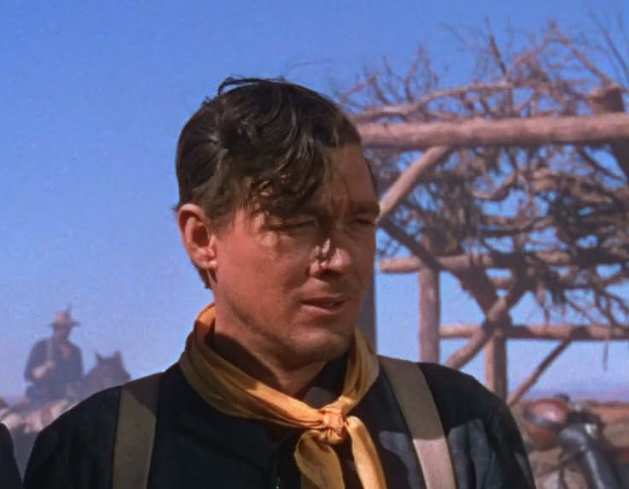
The decisive encounter happened in 1948 on the set of Fort Apache, when Johnson saved several people during an accident. Director John Ford, witness to the event, signed him and gave him roles in Three Godfathers and She Wore a Yellow Ribbon. Ford recognized in him that rare quality Peter Bogdanovich would later call “the real thing”: Johnson didn’t act the cowboy, he truly was one.
In 1949 he landed the lead role in Mighty Joe Young, followed the next year by Wagon Master, one of Ford’s favorite films. The collaboration with the western master solidified his reputation, but Johnson always maintained a complex relationship with the director. During the filming of Rio Grande, he challenged Ford, known for mistreating actors, reportedly telling him to go to hell. The incident cost
Johnson a decade-long absence from Ford’s films.
In 1952, Johnson paused his film career to pursue a youthful dream: becoming a rodeo champion like his father. In 1953 he won the Professional Rodeo Cowboys Association world title in team roping. By the end of the year, however, he found himself broke, with a rundown car and an angry wife. He returned to Hollywood, where roles alongside the biggest American film stars awaited him.
In Shane (1953), he played Chris Calloway, the redeemed villain after being beaten by Alan Ladd. He worked with Marlon Brando in One-Eyed Jacks (1961), Charlton Heston in Major Dundee (1965), William Holden in The Wild Bunch (1969). He made six films with John Wayne, inheriting some advertising spots for Great Western Savings after Wayne’s death. He collaborated with Sam Peckinpah on four films, building a solid professional relationship: the director valued Johnson’s authenticity and lack of theatrical affectation.
The peak of his career came in 1971 with Peter Bogdanovich’s The Last Picture Show. Johnson played Sam the Lion, the cinema owner and father figure in the small Texas town where the story unfolds. He initially refused the role: “It was the worst thing I’d ever read,” he told an Arizona journalist years later. “Every other word of my character was a curse, so I declined the offer.” John Ford convinced him, asking him to accept as a personal favor. Johnson rewrote his part, removing the vulgar language.
The performance earned him the Oscar for Best Supporting Actor, along with the Golden Globe, the New York Film Critics Circle Award, and the British BAFTA. At the Academy Awards ceremony, looking at the statue, he exclaimed: “Ain’t it purty?” Then added: “This couldn’t of happened to a nicer fella.” In 1972, on the set of The Train Robbers, he told Nancy Anderson of the Copley News Service that the Oscar wouldn’t change him nor increase his salary demands from studios. “I grew up on a ranch and know livestock, so I like working in westerns. I’ve been afraid of failing all my life. To avoid that, I stuck to what I know, and that’s earned me a good living.”
In the seventies and eighties, he continued working steadily. In 1972 he made two films with Steve McQueen: The Getaway and Junior Bonner, the latter set in the rodeo world. In 1973 he played Melvin Purvis in John Milius’ Dillinger, who directed him again in Red Dawn (1984). He appeared in Breakheart Pass (1975) with Charles Bronson and Bite the Bullet the same year with Gene Hackman and James Coburn. In 1979 he portrayed Cap Roundtree in the TV miniseries The Sacketts.
His last significant role came in 1994 with Disney’s Angels in the Outfield, where Johnson played an aging western actor turned baseball team owner, a role reminiscent of Gene Autry. It was his final screen appearance.
Throughout his film career, Johnson never abandoned the ranch. He managed a horse breeding farm in Sylmar, California, and from 1985 sponsored the Ben Johnson Pro Celebrity Team Roping and Penning, an annual competition held at the Lazy E Arena in Guthrie, Oklahoma, with proceeds benefiting the Children’s Hospital of Oklahoma and Children’s Medical Research Inc.
When he received his star on the Hollywood Walk of Fame in the early nineties, he commented with his typical sarcasm: “I don’t know why the hell you waited so long to give me a star. You waited until I was so old I could hardly enjoy it.”
In 1994 his wife Carol Elaine Jones, married since 1941 and lifelong companion, passed away. Two years later, on April 8, 1996, Johnson suffered a heart attack during a visit to his mother at a nursing home in Mesa, Arizona, where both lived. He was 77. He appeared in about three hundred films, leaving a cinematic legacy that represents the authenticity of the American West better than any other actor of his generation.

.jpg)