Samuel Wilder worked as a gigolo in Berlin dance halls when he was unable to sell his articles as a journalist. His mother nicknamed him “Billie” after attending a Wild West Show during a visit to New York, a name he Americanized to “Billy” once he emigrated to Hollywood in 1934, fleeing the rise of Nazism.
Wilder spoke approximate English when he arrived in the United States and initially collaborated with Charles Brackett precisely because Brackett could refine his dialogue. The pair wrote Ninotchka for Greta Garbo in 1939, a film that marked the Swedish actress’s comedic debut with the famous advertising phrase “Garbo laughs!”. The screenplay received an Oscar nomination.
His transition to directing came with The Major and the Minor in 1942, but it was Double Indemnity two years later that established Wilder as a full author. To adapt James M. Cain’s novel, Wilder convinced Raymond Chandler to collaborate on the screenplay despite the writer never having worked in cinema. The two constantly argued: Chandler hated Hollywood and Wilder found the writer impossible to manage. The result was one of the most influential screenplays of American noir, nominated for an Oscar.
The Lost Weekend in 1945 brought Wilder his first statuettes for directing and screenplay, as well as the award for best picture. Paramount was so concerned the film would damage the image of the alcohol industry that it considered not distributing it. The distillers’ industry offered five million dollars to buy and destroy the film. The movie also won the Palme d’Or at Cannes, uniquely alongside Marty and Parasite in winning both the Oscar and the highest French award.
The collaboration with Brackett ended after Sunset Boulevard in 1950. Gloria Swanson, who played the faded star Norma Desmond, was fifty years old when she filmed and had not appeared on screen for nine years. Wilder cast real silent film stars such as Buster Keaton and Erich von Stroheim, who in the film plays Norma’s ex-husband and director, a role reflecting his own career as a disgraced filmmaker. The screenplay won the Oscar and the film received eleven total nominations.
Ace in the Hole in 1951 was Wilder’s first commercial failure. Kirk Douglas played a journalist who manipulates the rescue of a man trapped in a cave to prolong the scoop. Paramount changed the title to The Big Carnival after disastrous early weeks, but it did not save the box office. Wilder considered this film among his best works.
With Stalag 17 in 1953, Wilder directed William Holden to an Oscar win for best actor. The film, set in a Nazi prisoner-of-war camp, mixed comedy and drama in a way that was controversial at the time. Holden initially refused the role because he found the character unlikeable.
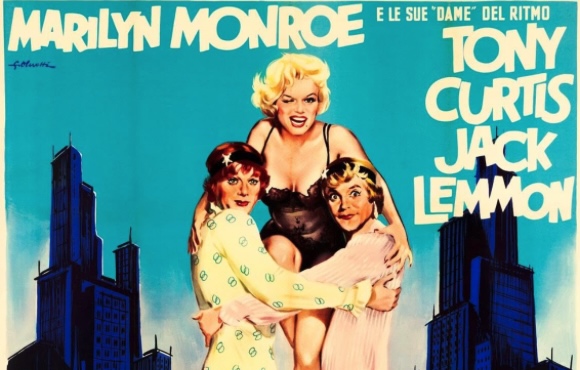
Marilyn Monroe arrived late on the set of The Seven Year Itch in 1955 and often forgot her lines, forcing Wilder to shoot dozens of takes for simple scenes. Despite difficulties, the scene of her dress lifted by the subway air became one of the most reproduced images in film history. When Wilder worked again with Monroe in Some Like It Hot four years later, problems intensified: the actress arrived hours late and required fifty-nine takes to correctly say “It’s me, Sugar” in one scene. Wilder said he would never work with her again but also admitted her screen presence was irreplaceable. The film received six Oscar nominations.
In 1957 Wilder completed three films: The Spirit of St. Louis with James Stewart, Love in the Afternoon with Audrey Hepburn and Gary Cooper, and Witness for the Prosecution with Tyrone Power in his last full performance before death. The latter earned Wilder another nomination for best director.
The partnership with I.A.L. Diamond began with Some Like It Hot and produced twelve films over twenty-four years. Diamond worked at the typewriter while Wilder paced the room smoking cigars and tossing out lines. They wrote every morning from nine to six, five days a week.
The Apartment in 1960 earned Wilder three Oscars in one night: best picture, best director, and best original screenplay. Jack Lemmon, the film’s lead, said Wilder often shot over a hundred takes for a single scene, not because the actors erred but because he sought a specific nuance in the performance.
Wilder received twenty-one Oscar nominations over his career, winning six. In 1987 the Academy awarded him the Irving G. Thalberg Memorial Award. Five of his films were nominated for best picture and two actually won.
After Fedora in 1978 and Buddy Buddy in 1981, Wilder was unable to secure funding for new projects. He spent his last twenty years collecting modern art, with a particular preference for Picasso and Egon Schiele. His collection was auctioned by Christie’s in 1989 for over thirty-two million dollars.
Wilder died in Beverly Hills on March 27, 2002. On his gravestone at Westwood Village Memorial Park Cemetery is the epitaph he personally chose: “I’m a writer but then nobody’s perfect,” a quote recalling the final line of Some Like It Hot.