When observing Diane Kruger’s professional trajectory, an unusual pattern emerges by Hollywood standards: an actress who has built her artistic identity by refusing to anchor herself to a single national industry. Born in Algermissen, West Germany in the 1970s, Kruger has navigated cinema as one crosses linguistic borders, moving from German to French to English without ever betraying an accent of definitive belonging.
Her training at the Royal Ballet School in London marked the first chapter of this nomadic education. A knee injury prematurely ended her classical dance ambitions, but that physical discipline would resurface years later in the physical construction of her film characters. Her passage through Parisian runways, after winning the Elite Model Look title in 1992, constituted a second apprenticeship: that of stage presence, the ability to inhabit others’ gaze without dissolving into it.
Her film debut came in the late 1990s, but it was Wolfgang Petersen who, in 2004, offered her the role that would define the first phase of her career: Helen of Troy in Troy. Petersen’s choice was no accident. He needed a face that could justify a millennial war, and Kruger possessed that elusive quality that makes obsession believable. Alongside Brad Pitt and Eric Bana, the German actress embodied not so much beauty as the idea of beauty, the one Homer rendered legendary without ever describing it in detail.
That same year, Jon Turteltaub cast her in National Treasure, entrusting her with the role of art historian Abigail Chase. The character, reprised in the 2007 sequel, allowed her to explore a different register: intelligence as a form of seduction, professional competence as a central narrative element. These were the years when Hollywood was trying to build franchises around female figures who were not mere romantic appendages to male protagonists, and Kruger fit naturally into that transition.
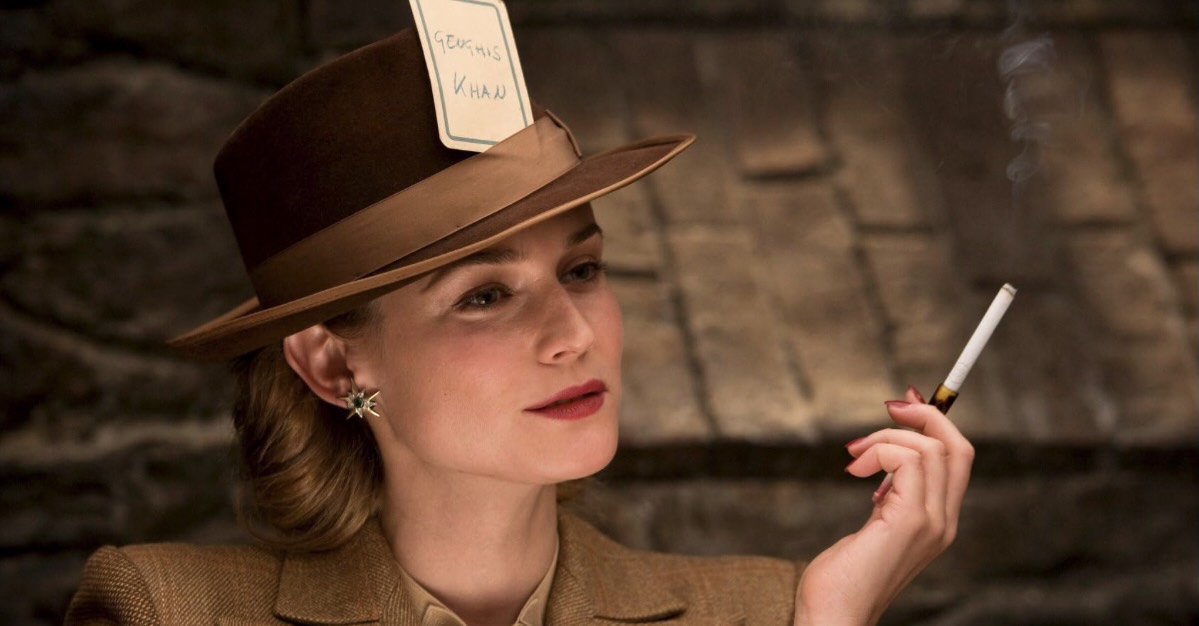
In 2003, the Cannes Film Festival awarded her the Trophée Chopard, a recognition for emerging actors. But critical consecration came six years later when Quentin Tarantino chose her to play Bridget von Hammersmark in Inglourious Basterds. The character of the German actress turned Allied spy during World War II required a complex layering: 1940s Hollywood glamour, European cynicism, desperate courage. Kruger built that figure with almost surgical precision, earning Screen Actors Guild Award nominations both as supporting actress and for the ensemble cast.
Her absence from the 2010 Oscar nominations marked the first in a series of missed inclusions that would characterize her relationship with the Academy. Awards season observers noted that her performance met all the requirements for a nomination: a memorable role in a critically and commercially successful film, an iconic scene (the tight shoe revealing her identity), presence in a film by a director beloved by the industry. Yet, the call never came.
Kruger responded to that phase of Hollywood visibility by alternating mainstream productions with riskier projects. In 2011, she accepted Unknown by Jaume Collet-Serra, a thriller with Liam Neeson in which she played an undocumented Bosnian immigrant in Berlin. The character required a moral opacity that contrasted with the glamorous roles offered to her, and the actress inhabited it with an expressive subtraction that revealed interpretive maturity. In 2013, television seriality attracted her with The Bridge, where for two seasons she portrayed detective Sonya Cross, a character with traits on the autism spectrum. The FX series allowed her to explore narrative continuity impossible in cinema, building a character over twenty-four episodes instead of two hours.
2017 marked a biographical as well as professional turning point. Fatih Akin convinced her to act for the first time in German in In the Fade (Aus dem Nichts). The choice to return to her mother tongue after twenty years of international career was not simple. Kruger has recounted in interviews how that linguistic return required an emotional repositioning, a renegotiation of her acting identity. The character of Katja Şekerci, a woman who loses her husband and son in a neo-Nazi terrorist attack, forced her to work on expressive registers never explored before: pain without mediation, despair without glamour, revenge as the only form of survival.
The Cannes jury, presided over by Pedro Almodóvar, awarded her the Palme d’Or for Best Actress. In her acceptance speech, Kruger dedicated the prize to the victims of terrorism but added a personal reflection: the film represented a confrontation with her own Germanness, with a national history that continues to produce monsters. That Cannes victory seemed to open the way to an Oscar nomination, especially since Germany selected the film as its official candidate for Best International Feature.
Awards season analysts built narratives around her possible candidacy: the European actress conquering Hollywood, the foreign-language performance transcending linguistic barriers, the return to origins after years of voluntary exile. When the 2018 Academy Award nominations were announced, Kruger’s name did not appear on the list. Frances McDormand, Sally Hawkins, Margot Robbie, Saoirse Ronan, and Meryl Streep were the chosen ones. The exclusion sparked debates about the difficulty for non-English-speaking actors to penetrate American awards dynamics, even with prestigious credentials like a Palme d’Or.
That missed nomination revealed something structural in Kruger’s relationship with the Hollywood industry: professional respect that never translates into institutional celebration. The actress has continued to work regularly but always in a liminal position, neither fully inside nor completely outside the system.
In 2019, she joined the cast of The 355, a spy thriller ensemble, and acted alongside Martin Freeman in The Operative. In 2023, David Cronenberg cast her in The Shrouds, entrusting her with three distinct characters in the same film. The project, presented in 2025, represented a technical and interpretive challenge: building three separate identities while maintaining recognizable directorial coherence. Cronenberg stated that Kruger’s choice derived from her ability to be simultaneously present and elusive, an essential quality for a film about death and memory.
Alongside her acting career, Kruger has accumulated institutional roles in the festival circuit: juror at Berlin in 2008, Cannes in 2012 under Nanni Moretti’s presidency, Venice in 2015 with Alfonso Cuarón as jury president. In 2025, she presided over the jury of the Angoulême Francophone Film Festival. These roles certify a recognition that transcends individual awards: that of a figure respected by the three main European film industries.
France awarded her the Order of Arts and Letters in 2014, a recognition usually given to artists who have contributed to French culture. For Kruger, who has lived in Paris for decades and acted in numerous French films, that title represented a symbolic adoption. In 2023, the Zurich Film Festival gave her the Golden Eye Award, a career prize that seals a trajectory now spanning thirty years.
Looking back at her filmography, an actress emerges who has built her professional identity through subtraction rather than accumulation. No Oscars, no billion-dollar blockbusters, no decade-long franchises. Yet, a constant presence in both auteur and mainstream cinema, a capacity to cross languages and registers that few colleagues possess. Perhaps it is precisely this elusiveness that defines her: an actress who exists in the interstices between national industries, never fully belonging to any.