Adrienne Levine grew up in Long Island in a Jewish family, daughter of Sheldon Levine and Elaine Langbaum. At ten years old, she began acting at the Stagedoor Manor Performing Arts Training Center, and her professional debut came with a summer production of the musical "Annie" while attending Jericho High School. She enrolled at Boston University to study film production but left in her third year to move to Manhattan. She was twenty-three when Hal Hartley cast her in "The Unbelievable Truth" in 1989.
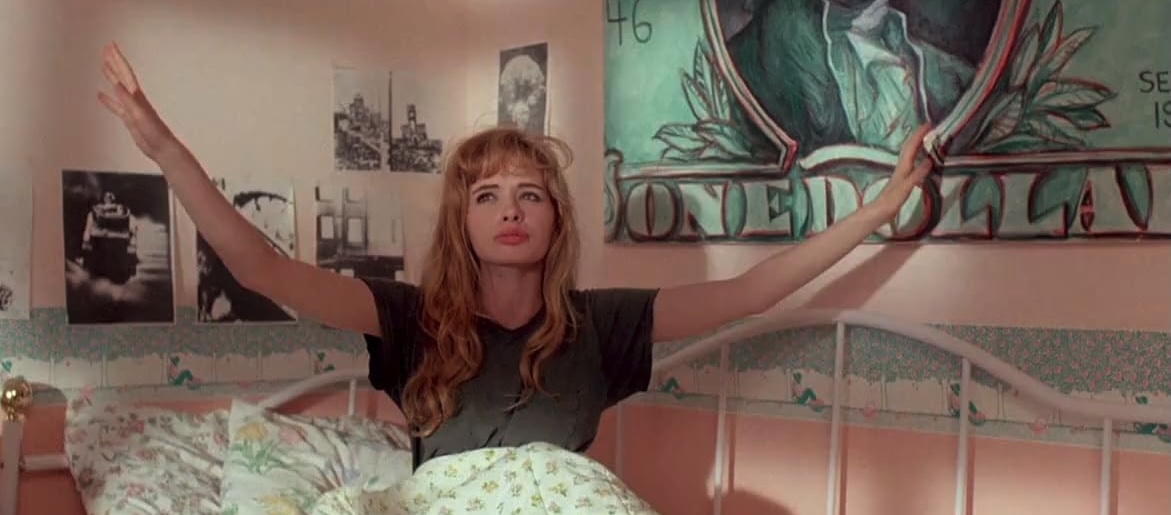
That film marked the beginning of a collaboration that would define American independent cinema in the early 1990s. Hartley, a Long Island native director known for his distinctive style of rigid dialogue and precise visual geometry, found in Shelly the ideal interpreter for his female characters. "The Unbelievable Truth" introduced her as Audry Hugo, a girl obsessed with the end of the world who falls in love with a mechanic recently released from prison. The film was low-budget, shot in black and white, but established Hartley as an original voice in independent cinema.
The following year came "Trust," the second chapter of Hartley’s so-called Long Island Trilogy. Shelly played Maria Coughlin, a high school student who becomes pregnant and is kicked out of her home. The character meets Matthew, an idealistic electronics technician played by Martin Donovan, and between them develops a love story built on terse dialogue and measured gestures. The film premiered at the 1991 Sundance Film Festival, where Hartley’s screenplay won the Waldo Salt Screenwriting Award ex aequo. "Trust" was nominated for the Grand Jury Prize, but Shelly received no individual recognition. The film solidified her reputation as an independent film actress but did not push her beyond that niche.
During the 1990s, she appeared in over twenty films, often low-budget productions circulating in festivals but not reaching a wide audience. She appeared in "Hold Me, Thrill Me, Kiss Me" in 1992, "Hexed" in 1993, and "The Road Killers" in 1994. She also worked in television, with appearances in "Law & Order," "Homicide: Life on the Street," and "Oz." In 2005, she acted in "Factotum" alongside Matt Dillon, an adaptation of Charles Bukowski’s novel directed by Bent Hamer. This was one of her last roles as an actress.
Her transition behind the camera began in the late 1990s. In 1997, she wrote and directed "Sudden Manhattan," followed in 1999 by "I’ll Take You There," in which she acted alongside Ally Sheedy. The latter film earned her the U.S. Comedy Arts Festival Film Discovery Jury Award in 2000 for directing and a special mention at the Festróia International Film Festival in Setúbal, Portugal. These recognitions came from specialized festivals, not the Academy. Shelly was building a solid but marginal career, distant from the circuits that lead to Oscar nominations.
In 2002, she married Andy Ostroy. The following year, their daughter Sophie was born. Shelly continued to work in off-Broadway theater, taught acting at One on One Productions in Manhattan, and conducted workshops at NYU on acting, directing, and writing. She served as creative director of the Missing Children Theater company for five years. She wrote and directed shows for Naked Angels and Alice’s 4th Floor. Her professional life was divided between cinema, theater, and teaching, with a constant presence in New York’s artistic scene.
"Waitress" was born from that experience. Shelly wrote the screenplay, directed the film, designed part of the costumes and sets, and played Dawn, a colleague and friend of the protagonist Jenna, a waitress trapped in an abusive marriage who dreams of opening a bakery. Keri Russell played Jenna, Nathan Fillion the doctor she falls in love with, Jeremy Sisto the abusive husband. Andy Griffith, a legend of American television, accepted a supporting role. Her daughter Sophie appeared in a final cameo.
The film was accepted at the 2007 Sundance Film Festival. Shelly never saw that screening. On November 1, 2006, she was found dead in her Manhattan office. Initially, her death was classified as suicide, but her husband Andy Ostroy insisted on further investigation. Police arrested Diego Pillco, a nineteen-year-old Ecuadorian working on a construction site in the building. Pillco confessed to killing Shelly after an argument over construction noise. He strangled her and staged a hanging to simulate suicide. He was sentenced to twenty-five years in prison.
"Waitress" premiered at Sundance in January 2007. Fox Searchlight Pictures bought the distribution rights for between four and five million dollars. The film was released in theaters on May 2, 2007, and grossed over twenty-two million dollars at the American box office. Critics received it positively, with an 89% score on Rotten Tomatoes. Shelly received a posthumous nomination for the Independent Spirit Award for Best Screenplay and a nomination for the Humanitas Prize in the Sundance category. No Oscar nominations followed.
The Academy did not consider "Waitress" for the main categories. The film remained confined to the independent circuit despite commercial and critical success. Keri Russell did not receive a nomination for lead actress. Shelly’s screenplay, although appreciated, did not make the shortlist. In 2008, the Oscar for Best Original Screenplay went to Diablo Cody for "Juno," an independent comedy with similar themes about pregnancy and female self-determination. "Waitress" was left out.
Andy Ostroy founded the Adrienne Shelly Foundation after his wife’s death. The nonprofit awards scholarships, production funding, completion funds, and stipends through partnerships with institutions such as NYU, Columbia University, Women in Film, Sundance Institute, Tribeca Film Institute, and Nantucket Film Festival. Cynthia Wade, one of the foundation’s grant recipients, won the 2008 Oscar for "Freeheld," a documentary the foundation helped finance. Eight years later, Chloé Zhao, who had received a grant for a short film from the foundation, became the second woman to win the Oscar for Best Director.
The Women Film Critics Circle established the Adrienne Shelly Award, an annual recognition given to the film that "most passionately opposes violence against women." In February 2007, "Law & Order" aired an episode titled "Melting Pot," loosely inspired by Shelly’s murder. The plot altered real events, attributing the crime to the employer of the undocumented worker to protect business interests. Shelly had appeared on the show in 2000, in the episode "High & Low."
"Waitress" became a Broadway musical. It debuted in April 2016 with Jessie Mueller as Jenna and ran until January 2020, with over 1,500 performances. Sara Bareilles composed the music and performed as Jenna in several runs. The musical received four Tony Award nominations in 2016 but did not win. Another Shelly screenplay, "Serious Moonlight," was directed by Cheryl Hines and released in 2009 with Meg Ryan and Timothy Hutton. That film also received no Oscar nominations.
In 2021, HBO aired "Adrienne," a documentary directed by Andy Ostroy about his wife’s life and legacy. The film includes interviews with colleagues, friends, and family and addresses both her artistic career and the circumstances of her death. Shelly was forty years old when she was killed. Her career was still growing, and "Waitress" represented a turning point that could have led her to larger productions and greater recognition.
The absence of Oscar nominations accompanied her entire career. "Trust" received recognition at Sundance for Hartley’s screenplay but not for her performance. "I’ll Take You There" won awards at specialized festivals but did not enter the Academy’s radar. "Waitress" received nominations at the Independent Spirit Awards and the Humanitas Prize, important recognitions in the independent circuit but insufficient to attract Oscar voters’ attention. Her legacy survives through the foundation bearing her name, through the musical still performed worldwide, and through the filmmakers she inspired and those her foundation continues to support.

.jpeg)