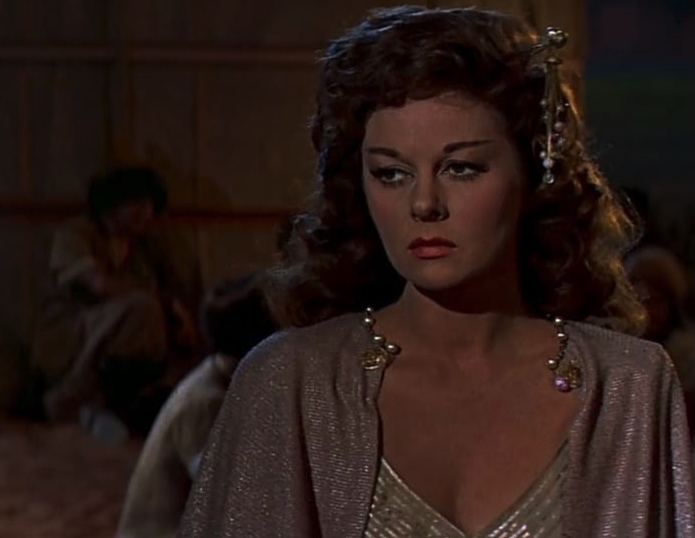
Edythe Marrenner arrived in Hollywood in 1937 with a clear goal: to play Scarlett O’Hara in Gone with the Wind. David O. Selznick called her for an audition that would change her life, although not in the way she hoped. The Brooklyn girl did not get the role that launched Vivien Leigh, but that trip to California opened the doors of Warner Brothers studios, where she took the name Susan Hayward.
The early years were a succession of secondary roles and B-movie productions. The turning point came in 1942 with Cecil B. DeMille’s Reap the Wild Wind, where she played a fiery Southern girl who caught the critics’ attention. But true recognition came late. Hayward worked steadily, gaining experience in films that left little mark on collective memory, until the late 1940s.
In 1947, producer Walter Wanger signed her with a salary of one hundred thousand dollars a year, a considerable sum for the time. The first fruit of this collaboration was Smash-Up: The Story of a Woman, where Hayward portrayed an alcoholic nightclub singer inspired by Dixie Lee. The performance earned her the first Oscar nomination for Best Actress. The film did not convince critics but won over audiences, turning Hayward into a star.
The second nomination came two years later with My Foolish Heart (1949), produced by Sam Goldwyn for 20th Century Fox, a studio with which the actress would establish a long partnership. The 1950s marked the peak of her career. In 1951, she starred alongside Gregory Peck in David and Bathsheba, the year’s most popular film, consolidating her status as a leading lady.
The third Oscar nomination arrived in 1952 for With a Song in My Heart, a biopic of singer Jane Froman. Hayward disliked her own voice and often expressed reluctance to play singers, but in this case, Froman’s voice was recorded and used while the actress performed the musical scenes. The film also earned her the Golden Globe for Best Actress in a Comedy or Musical.
In 1955, MGM hired her to play Lillian Roth, an alcoholic actress and singer, in I’ll Cry Tomorrow, based on Roth’s bestselling autobiography. This time Hayward sang with her own voice, dispelling years of incorrect attributions to professional ghost singers. The performance won her Best Actress at the Cannes Film Festival and a fourth Oscar nomination. The film was a significant commercial success.
The following year, Howard Hughes chose her for The Conqueror (1956), a historical epic with John Wayne filmed in the Utah desert near an active nuclear test site. The film was panned by critics but performed well at the box office. Years later, speculation arose about a possible link between filming in that area and cancers that affected several cast and crew members, including Wayne and Agnes Moorehead.
The fifth and final nomination, which was also the winning one, came in 1958 with I Want to Live!, another collaboration with Walter Wanger. Hayward portrayed Barbara Graham, a woman sentenced to death for murder. The film, based on Graham’s personal letters and articles by journalist Ed Montgomery of the San Francisco Examiner, presented a heavily dramatized version of the case, suggesting the protagonist’s possible innocence. The screenplay by Nelson Gidding and Don Mankiewicz gave her a complex character, a sarcastic and carefree B-girl who descends into terror and final surrender as execution approaches.
Bosley Crowther of The New York Times wrote that Hayward acted superbly under Robert Wise’s direction, calling her performance worthy of the highest applause. Variety noted it was hard to think of another star capable of bringing such a complex characterization to the screen. John L. Scott of the Los Angeles Times described it as a sensational and devastating performance, worthy of Academy Award consideration. Hayward won the Oscar, the Golden Globe, the New York Film Critics Circle Award, and other international honors. She was awarded thirty-seven percent of the film’s net profits.
The film sparked controversy. Gene Blake, the reporter who covered the real trial for the Los Angeles Daily Mirror, called it a dramatic and eloquent piece of propaganda for abolishing the death penalty. William H. Parker, Los Angeles police chief, disputed the unjustified premise of an innocent led to death, stating that Graham had in fact beaten and strangled the elderly widow Monahan.
After the 1958 triumph, Hayward’s career slowed. She remarried and moved to Georgia, where she bought a farm near Carrollton. She continued acting but less frequently. Films like Thunder in the Sun (1959), Ada (1961), and Back Street (1961) did not replicate previous successes. In 1967, she appeared in Valley of the Dolls, her last feature film. In subsequent years, she acted in three television films, all aired in 1972, and performed in a theatrical production of the musical Mame in Las Vegas between 1968 and 1969.
In 1972, she was diagnosed with an inoperable brain tumor. She received treatment at Emory University Hospital in Atlanta before returning to California. She died in Beverly Hills on March 14, 1975, and was buried in Georgia, in the cemetery of the Catholic church Our Lady of Perpetual Help in Carrollton, next to her husband Eaton Chalkley.
Susan Hayward’s star on the Hollywood Walk of Fame, at 6251 Hollywood Boulevard, was unveiled on February 8, 1960, when her career was still at its peak. She remains one of the most Oscar-nominated actresses without winning before the fifth attempt, a testament to a career built on tenacity and interpretive skill that found its fullest expression in complex female characters, often inspired by true stories.



.jpg)