Eleanor Parker’s career was built on a series of strategic refusals. While many actresses of classic Hollywood accepted any role studios offered, Parker accumulated contract suspensions with a determination that would define her entire professional path. Warner Bros kept, according to her own words in 1953, “a list a mile long” of her rebellions. Yet that stubbornness earned her three Oscar nominations in five years, a feat few colleagues achieved during the golden age of the studio system.
Her contract with Warner Bros arrived in June 1941, when Parker had just turned nineteen. A talent scout, Irving Kumin, had spotted her in the audience at the Pasadena Playhouse. Her apprenticeship began with minor roles in B-movies like Busses Roar and The Mysterious Doctor, but the real break came when Joan Leslie got stuck on the set of Rhapsody in Blue and Parker replaced her in Between Two Worlds alongside Paul Henreid. From that moment, the studio began considering her for more substantial parts.
Her first major opportunity was Of Human Bondage (1946), where she played Mildred Rogers in the adaptation of Somerset Maugham’s novel. Director Edmund Goulding called her one of the five greatest American actresses, but disappointing previews convinced the studio to shelve the film for two years. When it finally released, audiences remained cold. Parker, however, never disowned that performance: in 1953 she still cited it as her favorite role, a rare admission for an actress who had already collected more visible successes.
The true professional turning point came with Pride of the Marines (1945), where she starred alongside John Garfield. “Who wouldn’t look good with John Garfield?” she said years later, but that modesty hid the awareness of having found the right tone. Subsequent films with Errol Flynn, Never Say Goodbye and Escape Me Never, proved commercial disappointments. Parker reacted by refusing roles in Stallion Roadand Love and Learn, earning two suspensions. When the studio wanted her for Somewhere in the City, she refused again and Virginia Mayo took her place.
Between 1947 and 1948, Parker worked only six months, but not as studio punishment. She had married and had a child, and when offered The Hasty Heart she declined because filming in England would keep her away from her baby during the first year of life. “All my life I wanted a child, and whatever might happen professionally because of that would never feel like a loss,” she said in a 1949 interview.
Her return to screens came with Chain Lightning alongside Humphrey Bogart, but it was Caged (1950) that definitively transformed her career. Parker had heard about this film on life in a women’s prison and pushed to get the part. She got it, and her portrayal of a young inmate earned her the Volpi Cup at the Venice Film Festival and her first Oscar nomination for Best Actress. She did not win the statuette, but that nomination marked the start of an extraordinary five-year span.
In February 1950, after eight years, Parker left Warner Bros. The studio had promised her a film titled Safe Harbor that they had no intention of producing. Her agents negotiated her release from the contract, and Parker found herself a freelancer in an era when most stars remained tied to studios. The start was difficult: Valentino (1951), where she played a fictional wife of Rudolph Valentino, was a failure, as was the comedy A Millionaire for Christy.
Then came William Wyler’s Detective Story, where she acted alongside Kirk Douglas. Parker played Mary McLeod, the wife of an unstable detective, in a performance that remains the shortest ever nominated for Best Actress. The nomination came in 1952, her second in two years. Some critics argued it was a “reflex” nomination, favored by the success of Caged the previous year, but Parker had by then consolidated her reputation.
In 1951 she signed a contract with Paramount for one film a year, keeping the option to work elsewhere. Simultaneously, while shooting Escape from Fort Bravo in 1953, she signed a five-year deal with MGM. This dual affiliation granted her unusual freedom and prestigious roles. For MGM, she played an actress in love with a noble swordsman in Scaramouche alongside Stewart Granger, a film that became a massive hit despite Parker admitting years later that Granger was the only person she did not get along with in her entire career.
Her third Oscar nomination came with Interrupted Melody (1955), where she portrayed Australian opera singer Marjorie Lawrence, struck by polio and confined to a wheelchair. Parker studied singing specifically for the role, and the film was a major commercial success. She herself called it her favorite film, replacing Of Human Bondage in her public statements. In a 1954 interview, she had listed Caged and Detective Story as her best works, and Chain Lightning, Escape Me Never, Valentino, and The Woman in White as the worst. But Interrupted Melody surpassed them all.
That same year she appeared in Otto Preminger’s The Man with the Golden Arm, playing Zosh, the paralyzed wife of Frank Sinatra’s heroin-addicted drummer. The film, based on a National Book Award-winning novel, was a critical and commercial success. Parker worked again with Sinatra in Frank Capra’s A Hole in the Head (1959), but by then her career was entering a different phase.
In 1956 she starred alongside Clark Gable in Raoul Walsh’s The King and Four Queens, and the following year she played three distinct personalities in the low-budget psychological thriller Lizzie by Hugo Haas. The performance impressed even Shirley Jackson, author of the novel The Bird’s Nest on which the film was based. But leading roles began to thin out.
Madison Avenue (1962) marked her last leading role in cinema. Parker gradually shifted toward television, appearing in the series Bracken’s World between 1969 and 1970, which earned her a Golden Globe nomination for Best Actress in a Drama Series. One of her last notable film roles was the Baroness in Robert Wise’s The Sound of Music (1965), a secondary but memorable part in one of cinema’s most celebrated musicals.
On February 8, 1960, she received a star on the Hollywood Walk of Fame, a recognition that came as her film career was already declining. She continued working in films and TV series until 1991, mostly in minor roles that could not compete with those of her golden years. Her last film was Dead on the Money for TNT in 1991.
Parker died on December 9, 2013, in Palm Springs, California, at ninety-one years old, due to complications from pneumonia. She left four children from four marriages: Fred Losee, married in 1943 and divorced the following year; producer Bert E. Friedlob, married in 1946 and divorced in 1953; artist Paul Clemens, married in 1954 and divorced in 1965; and Raymond N. Hirsch, married in 1966 and remained by her side until his death in 2001.
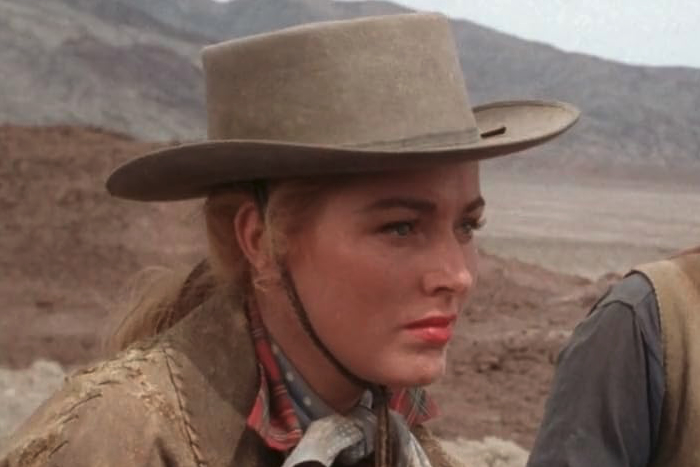
Her professional legacy remains that of an actress who refused to bend to studio logic when it contradicted her artistic vision. “I maintain that if you work, believe in yourself, and do what’s right for you without stepping on others, somehow the way opens,” she said in 1953. “I don’t mean just sitting around. Warner still has that mile-long list of my suspensions for refusing certain roles. Anyway, I never did a western. Not one. And it was worth it.”
That determination cost her months of salary and probably some opportunities, but it also earned her three Oscar nominations and a career built on her own terms. In an era when the studio system controlled every aspect of actresses’ professional lives, Eleanor Parker proved it was possible to say no and survive. Indeed, to thrive.

.jpeg)