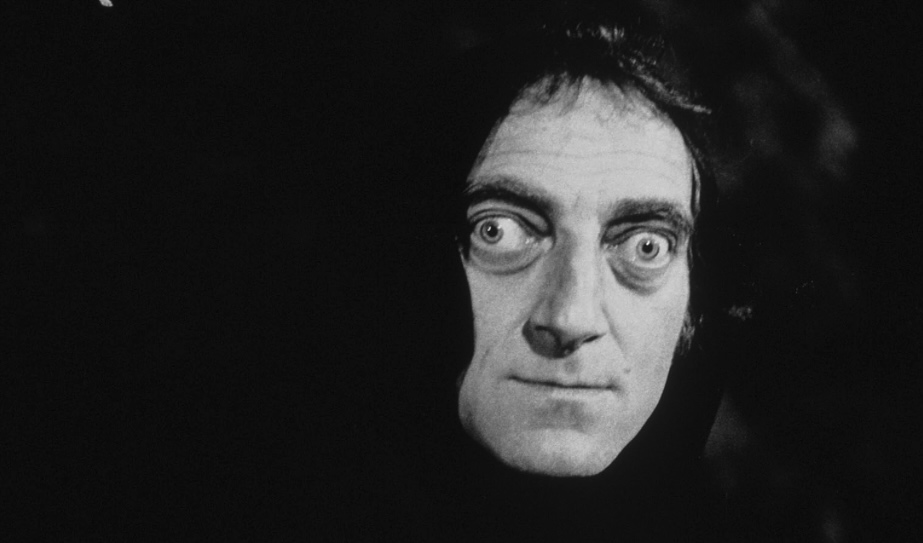
Marty Feldman was born on July 8, 1934, in London. His career developed around a distinctive feature: a face marked by unusual physical traits that became his trademark in the world of comedy. Coming from London’s East End and a family of Ukrainian descent, Feldman left school at fifteen intending to become a jazz trumpeter. His first variety show performance earned him the reputation of being the "worst trumpet player in the world," an episode that nonetheless marked the beginning of a path that would influence British comedy in the 1960s.
Before establishing himself as an actor, Feldman gained recognition as a writer. In collaboration with Barry Took from 1954 to 1974, he wrote for BBC radio programs such as "Round the Horne," a notable series in British radio comedy. The duo also contributed to "Bootsie and Snudge," a sitcom produced by Granada Television, solidifying their position among the most respected comedy writers in the UK. Denis Norden described them as leading comedy writers of their time.
Feldman’s transition to acting occurred with "At Last the 1948 Show," where he worked alongside Graham Chapman, John Cleese, and Tim Brooke-Taylor, figures later known for Monty Python and the Goodies. In this context, the sketch "Four Yorkshiremen" was co-written with colleagues and later adopted by Monty Python. In March 1967, Feldman played a character known as Mr. Pest, who tormented a shop assistant played by Cleese by requesting nonexistent books, succeeding only with "Ethel the Aardvark Goes Quantity Surveying."
In 1968, the BBC gave Feldman his own series, "Marty," which earned him two BAFTA awards, including Best Entertainment Performance in 1969. The second season, titled "It’s Marty," won the Golden Rose Award at the Montreux festival, opening the door to cinema. His film debut came with "Every Home Should Have One" in 1970, one of the most successful British comedies at the box office that year.
In 1971, Associated Television and the American Broadcasting Company co-produced "The Marty Feldman Comedy Machine," a sketch series filmed at Elstree Studios. The show lasted one season but introduced Feldman to American audiences. His appearance on "The Dean Martin Show" further strengthened his presence in the U.S., setting the stage for his most iconic role.
In 1974, Mel Brooks cast him as Igor in "Young Frankenstein," a film written by Gene Wilder with Feldman specifically in mind for the role. Wilder described Feldman as "the heart and soul of the production," highlighting his personal take on classic monster movies. The set was marked by frequent interruptions due to uncontrollable laughter from cast and crew. In one scene, Feldman improvised the line "walk this way," descending stairs with a cane and inviting Wilder to mimic him, a moment Brooks kept in the final cut.
Another memorable scene involved Igor biting the fur fox stole worn by Elizabeth, played by Madeline Kahn. The improvised moment caused the entire cast and crew to burst into laughter. Wilder was struck seeing Feldman with the fox’s paw in his mouth; Feldman, a committed vegetarian, asked if it was a real fox. For this performance, Feldman received the Saturn Award for Best Supporting Actor from the Academy of Science Fiction, Fantasy and Horror Films. The film earned Oscar nominations for Best Sound and Best Adapted Screenplay, but Feldman was not nominated.
After "Young Frankenstein," Feldman appeared in Mel Brooks’ "Silent Movie" (1976), confirming their collaboration. That same year, he worked in Italian cinema with the erotic comedy "40 Gradi All’Ombra del Lenzuolo." In 1977, he made his directorial debut with "The Last Remake of Beau Geste," a parody of desert adventure films, in which he also acted alongside Michael York, Ann-Margret, and Peter Ustinov. The film did not achieve the expected success but demonstrated Feldman’s desire to oversee all aspects of comedic production.
His appearance on "The Muppet Show," in the episode "Arabian Nights," featured interactions with "Sesame Street" characters, notably Cookie Monster, in a cameo comparing their eyes, which became an iconic pop culture moment.
On December 2, 1982, while filming "Yellowbeard" in Mexico City, Feldman died of a heart attack in his hotel room at age forty-eight. One week earlier, he had said, "I’m too old to die young, and too young to grow old." His death interrupted the film’s production, which was released posthumously in 1983, marking the end of a career that spanned radio, television, and film with notable versatility.
Feldman never received an Oscar nomination nor won the award. His legacy is measured through BAFTA awards, the Saturn Award, and the influence he had on British and American comedy. Gene Wilder described him as an actor capable of turning every characteristic into a comedic element, proving that Hollywood could embrace unconventional faces when paired with talent and originality.


.jpg)