If it weren’t for a childhood illness that left him so fragile his mother feared he wouldn’t survive his baptism, James Cagney might never have developed the fierce determination that made him one of the most dynamic actors in American film history. Born in Manhattan’s Lower East Side to a family of Irish and Norwegian descent, Cagney grew up in poverty, and that formative toughness became the raw material for his most memorable performances.
Cagney’s film career began almost by chance when Al Jolson was so impressed by his stage performance in Penny Arcade in 1929 that he bought the rights to the play, securing Cagney a role in Warner Bros.’ film adaptation titled Sinner’s Holiday. But it was The Public Enemy in 1931, his fifth film, that turned the actor into a star. The gangster Tom Powers he played became an archetype, and Cagney found himself trapped in that role for years, despite his abilities extending far beyond the tough street criminal. The famous grapefruit-smashing scene on Mae Clarke’s face remains one of the most iconic moments in gangster cinema, even though Cagney himself did not particularly like being remembered for that gratuitous violence.
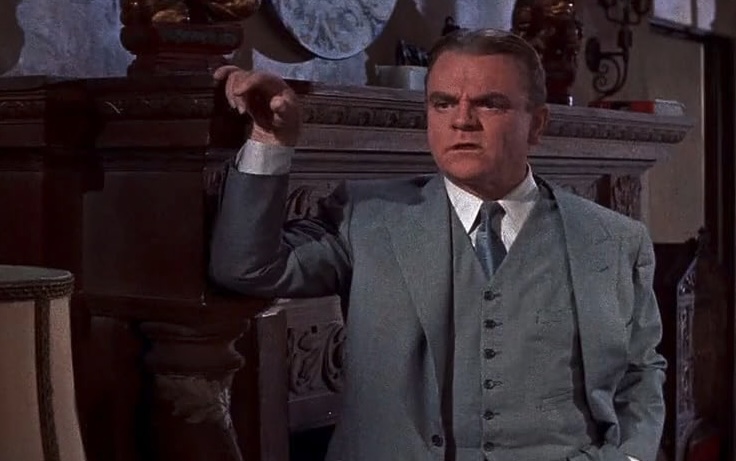
The turning point came with Angels with Dirty Faces in 1938, where he played Rocky Sullivan, a gangster freshly released from prison who confronts the boys from his old neighborhood who idolize him. The final scene, in which the character collapses while being led to the electric chair, remains ambiguous: is it true cowardice or a last act to disillusion the young who see him as a hero? Cagney himself always refused to clarify, preferring the interpretive ambiguity. That performance earned him his first Oscar nomination for Best Actor, but he lost to Spencer Tracy in Boys Town. Perhaps the pathos Rocky Sullivan lives is the same that Cagney poured into his performances, transforming violence into something more complex and human.
But Cagney was much more than a gangster on screen. He was an extraordinary dancer, nicknamed “Cellar-Door Cagney” as a boy for his habit of dancing on the slanted cellar doors of New York. When he portrayed George M. Cohan in Yankee Doodle Dandy in 1942, he was finally able to showcase his full talent. The film was born out of political necessity: in 1940, a Los Angeles jury had identified Cagney as a member or sympathizer of the Communist Party, and his producer brother William suggested making a film in which James played “the most patriotic man in the country.” Cagney worked with choreographer Johnny Boyle and meticulously studied Cohan’s stiff walk and characteristic dance style, fully transforming into the composer and showman. When Cohan saw the film, his first comment was, “My God, what a tough act to follow!” The performance earned Cagney the only Oscar of his career in 1943, beating Ronald Colman, Gary Cooper, Walter Pidgeon, and Monty Woolley.
The ordinary life of an actor sublimated itself, thus, into art, and typecasting was the armor Cagney wanted to shed. After Yankee Doodle Dandy, he left Warner Bros. to form his own production company with his brother William, Cagney Productions, seeking better control over his roles and to escape the gangster movie prison. He returned to the genre with White Heat in 1949, but this time the character Cody Jarrett was psychologically layered, a criminal with mental problems and a morbid attachment to his mother. The final scene, with Jarrett shouting “Made it, Ma! Top of the world!” as he explodes atop a gas tank, became one of the most quoted in American film history.
In 1955 came his third and final Oscar nomination, seventeen years after the first, for Love Me or Leave Mewith Doris Day. Cagney played Martin “Moe the Gimp” Snyder, a limping Jewish-American gangster from Chicago who becomes the obsessive manager and husband of singer Ruth Etting, a role Spencer Tracy had refused, considering it too unpleasant. When the film was released, Snyder himself asked how Cagney had so accurately copied his limp, but the actor insisted he had never met him, basing it instead on observing other people with similar disabilities. Doris Day called him “the most professional actor I ever knew,” noting how his eyes genuinely filled with tears during tender scenes without the need for tricks or artificial drops.
Cagney retired from acting in 1961 after Billy Wilder’s One, Two, Three, withdrawing to his 750-acre farm in Stanfordville, New York, which he named Verney Farm by combining his wife Frances Willard Vernon’s maiden name with his own. There he raised Morgan horses and beef cattle, and his dedication to agriculture earned him an honorary degree from Rollins College in Florida. Instead of simply attending the ceremony, Cagney wrote and presented a detailed essay on soil conservation and sustainable farming practices. He was also an avid painter, and in his 1975 autobiography Cagney by Cagney he stated he might have been happier, though poorer, as a painter rather than a movie star. Renowned painter Sergei Bongart gave him private lessons in his later years and owned two of Cagney’s works in his personal collection.
He returned to the camera only in 1981 for Miloš Forman’s Ragtime, mainly on medical advice after a stroke suggested he be more physically and mentally active. He played Police Commissioner Rhinelander Waldo in what would be his final film role. Orson Welles called him “perhaps the greatest actor who ever appeared in front of a camera,” and in 1999 the American Film Institute ranked him eighth on its list of the greatest male stars of Hollywood’s golden age, surpassed only by legends like Humphrey Bogart, Cary Grant, and James Stewart.
Cagney’s biography sublimates into art just as Kafka’s did in his stories. The unstoppable energy, the distinctive voice with that particular New York accent, the deadpan comic timing: all of this came from a sick boy from the Lower East Side who gave all his earnings to his family and danced on cellar doors. Like the shell that imprisons, the gangster typecasting never fully contained Cagney’s multifaceted talent, which continued to emerge in every performance, from musicals to psychological dramas, from comedy to war films. In 1984, Ronald Reagan awarded him the Presidential Medal of Freedom, recognizing not only his contribution to cinema but also his efforts during World War II with USO tours and his presidency of the Screen Actors Guild from 1942 to 1944.