
Avatar 3 - Fire and Ash: Interview with Sam Worthington, Stephen Lang, and the Cast
Avatar 3: Fire and Ash features interviews with Sam Worthington, Stephen Lang, Bailey Bass and Jack Champion.
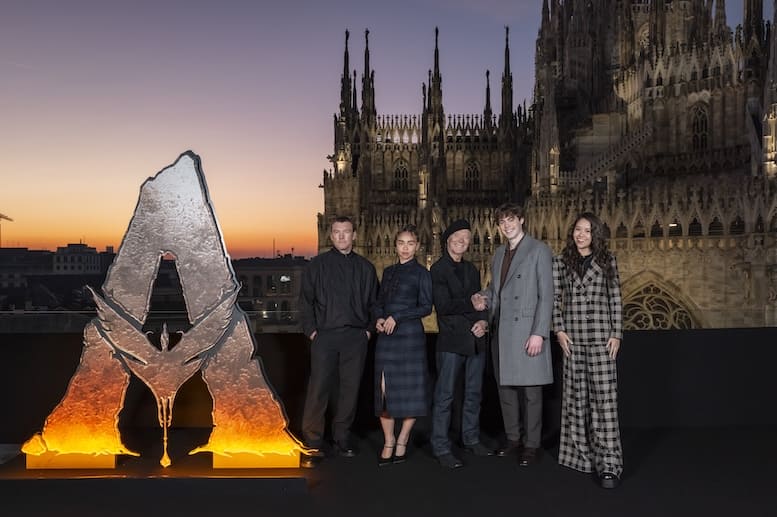
Avatar 3 - Fire and Ash is the upcoming movie. The plot unfolds a year after Jake and Neytiri’s family has settled with the Metkayina Clan, grappling with the grief over Neteyam’s death. Now, the Sully family and new tribe members must face the Na’vi, known as the People of Ash, led by Varang, who has allied with Jake’s enemy, Quaritch. We met the cast in Milan.

What is the new attitude of your character, Jake Sully, in the third movie of the series?
Sam Worthington: The Sully family is growing, and survival becomes a fundamental aspect. Circumstances change, and he must adapt to this new reality. The entire plot revolves around these transformations.
The third movie is much bolder. Certainly, the world has expanded. Therefore, emotions must deepen, but they still remain within the familiar territory of the second movie. I think that’s because we shot them simultaneously.
Each character is now seeking their place in the world; it’s inevitable, and Jake is one of them.

How do you consider this epic?
Stephen Lang: The benchmarks, I believe, are movies like Gone with the Wind, Lawrence of Arabia, and The Bridge on the River Kwai. Monumental movies that absolutely demand to be seen in theaters. I would also mention Federico Fellini’s 8½: being here in Italy means, on an international level, breathing in one of the centers of cinema, if not the very center. When I think of Fellini, Visconti, Antonioni, the great Giulietta Masina, and Marcello Mastroianni—I grew up watching that magnificent cinema, studying Bicycle Thieves. These are movies that struck me so deeply they made me want to enter this world, so it’s especially moving for me that we present our movie, Avatar, and screen it in this beautiful city.
Anyone who loves cinema and art will love this movie. Yes, I’m just enthusiastic. I adore how passionate and fierce this movie is, and how it captures attention. I think it assaults the senses, is immersive and visceral, empathetic: it made me cry, but also introduces new clans and interesting characters. We will meet the Wind Traders and the new villain Varang. How can something so wrong seem so right? “Variety” was our slogan for her, a very fitting description, and we will also deepen the characters we missed on screen and continue this journey with the Sully family.

How did you merge technology with acting?
Sam Worthington: We can design any scenario we need to interact with to tell our story correctly and truthfully because, you know, you can’t act pantomimically. Pantomime is the death of performance capture, and I tell every actor joining the cast that it’s necessary to anticipate things.
It’s just a big playground, and the only camera you really have to worry about is the one right in front of your head 24/7 inside the helmet, which means you’re always in close-up. You always have to give your best, so no one holds back. No one tries to get in the way of others.

Avatar is a movie made explicitly to be seen in theaters. What do you think about other ways of watching it?
Stephen Lang: Avatar is a movie made with the explicit purpose of being seen in theaters, which doesn’t mean you shouldn’t watch it a second, third, or fourth time. It will be shown on all kinds of platforms. But no other immersive quality compares to being in a cinema. I grew up watching movies in theaters: not long ago, I saw The Wizard of Oz, probably for the thirtieth time, and only about a year and a half ago I saw it on the big screen because I used to watch it on TV. When I was a kid, there was something called the “million dollar movie,” where they broadcast the same movie for a week, three times a day on TV, and sometimes I watched movies twenty-one times that week.
So, there are many ways to watch movies, but having watched movies for over sixty years, I can testify that nothing matches the experience of being in a dark theater. We live many shared experiences there with strangers. I don’t think this will ever change. I believe it will become even more defined. You know, some movies probably won’t be suitable for theaters, but in many ways, it’s up to the studios and their executives to create a model to make projects that make sense for this kind of venue.

You play Tsireya, the daughter of Tonowari and Ronal, who in the second movie develops a relationship with Lo’ak. How did you approach this character?
Bailey Bass: The relationship with the other actors was fantastic, and thanks to them, I got to know my character.
As an actor, I just had to trust James Cameron, trust the process, and I hope it showed on screen how easy it was for Tsireya to adapt to that world.
What do you think is the secret to the movie’s success?
Jack Champion: I believe it’s the great story, but also something everyone can identify with. I think it will touch everyone. Regardless of personal background, definitely.
You play Tuktirey, the daughter of Jake and Neytiri. What has this character left you?
Trinity Jo-Li Bliss: Being part of the Avatar family, growing alongside my character, has been a great honor. I wouldn’t be who I am today without this journey with Avatar and all these role models.
My character has now become part of me and will live inside me forever. I can’t believe how much I’ve grown as a person and as an actor. I’m truly grateful.
© All rights reserved


You Might Be Interested
Toy Story 5, Joan Cusack and Greta Gerwig interview
The statements of Joan Cusack and Greta Gerwig
Disclosure Day, Steven Spielberg and and Colman Domingo interview
The statements of Steven Spielberg and Colman Domingo
Disclosure Day, Emily Blunt interview
The statements of Emily Blunt and Josh O’Connor

Cape Fear, LA Premiere, Amy Adams, Javier Bardem and Lily Collias interview
The statements of Amy Adams, Javier Bardem and Lily Collias - Streaming starting June 5

Natalie Moon Interview
In the cast of *Backrooms*, directed by Kane Parsons

Scary Movie, Olivia Rose Keegan interview
The statements of Olivia Rose Keegan

Scary Movie, Kim Wayans interview
The statements of Kim Wayans

Scary Movie, Anna Faris interview
The statements of Anna Faris